
Criminal Law

click for a free consultation

Misdemeanor Resisting Law Enforcement in Indiana

There are two primary ways in which the state charges individuals with misdemeanor resisting law enforcement.  Typically, resisting law enforcement is thought of in the context of a fight or a struggle with police officers.  This is not always the case, as the state can also file resisting law enforcement for fleeing, or running away from the police, after the police have ordered the individual to stop. Misdemeanor resisting law enforcement cases often go to…


Read More
COVID-19 and Your Criminal Case

COVID-19 and Your Criminal Case

On December 15, the Indiana Supreme Court issued a new order suspending jury trials until March 1, 2021. This new order can (and likely will) impact your criminal case and there are a variety of matters your attorney should consider as soon as possible. Speedy Trial/Indiana Rules of Criminal Procedure 4 Under the United States and Indiana Constitutions, you have a right to a public and speedy trial, but that right is also part of…

Read More
The Mistake of Fact Defense

The Mistake of Fact Defense

Many crimes require what is known as “mens rea.” The literal translation of mens rea is “guilty mind.” In the realm of criminal litigation, mens rea essentially refers to a person’s criminal intent. Many crimes require the state to prove a defendant’s criminal intent as part of the elements of the crime charged. So what happens when there is activity that could be considered criminal, but the defendant, for whatever reason, did not act with…

Read More
The Crime of Assisting a Criminal

The Crime of Assisting a Criminal

An area of law that is frequently confused is the difference between the legal theory of accomplice liability and the crime of assisting a criminal.  While similar, it is important to understand that accomplice liability is a legal mechanism to hold all participants of a crime accountable.  Assisting a criminal, on the other hand, is its own crime that holds accountable those that help participants of a crime evade capture. Accomplice Liability The rationale behind…

Read More
What Constitutional Rights do I Waive by Pleading Guilty?

What Constitutional Rights do I Waive by Pleading Guilty?

Obviously, when a defendant pleads guilty in a criminal case, they understand they are going to be waiving certain rights, even some constitutional protections/rights. For example, most people know or assume that when they plead guilty to a criminal offense, they waive the right to remain silent. Clearly, in order to admit guilt in open court, one must waive their right to remain silent because they have to admit to what they did, audibly. That…

Read More
What is the Indiana Risk Assessment System or IRAS?

What is the Indiana Risk Assessment System or IRAS?

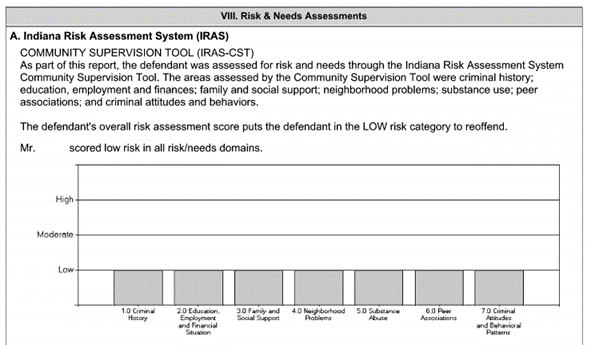
When people are being sentenced to a state crime in Indiana to a Level 6 or higher, many times courts will order what is referred to as a Pre-Sentence Investigation or “PSI.” For a closer look at what is contained within a PSI, please click here . Within that PSI, towards the back of the packet, defendants will see a bar chart that has different levels of risk listed, broken down by category, as follows:…

Read More
What is the Difference Between Competency and Sanity?

What is the Difference Between Competency and Sanity?

An area of law that is often confused is the concept of competency to stand trial versus insanity.  While these two concepts are often related, they have much different meanings in the context of a criminal case. Competency to Stand Trial Competency to stand trial is a very minimal standard.  A defendant is not competent to stand trial when he is unable to understand the proceedings and assist in the preparation of his defense.  If…

Read More
A question and answer perspective of a family member whose loved one is facing a sex crime and jail

A question and answer perspective of a family member whose loved one is facing a sex crime and jail

I would like to share my story not because it is so unique, but because, I believe, it is all too common.  To set the stage, I am the next of kin for my nephew who is now serving time for a Level 4 felony of child molestation.  I will reference the 5 stages of grieving developed by psychiatrist Elisabeth Kübler-Ross: Denial, Anger, Bargaining, Depression and Acceptance. Q: As a loved one of someone charged with…

Read More
fact-checked-image

This page has been written, edited, and reviewed by a team of legal writers following our comprehensive editorial guidelines. This page was approved by Founding Partner, Brad Banks who has more than 20 years of legal experience as a criminal defense attorney.